Caffeine on Top of Corticosteroids: Navigating Coffee and Energy Drinks While on Prednisone
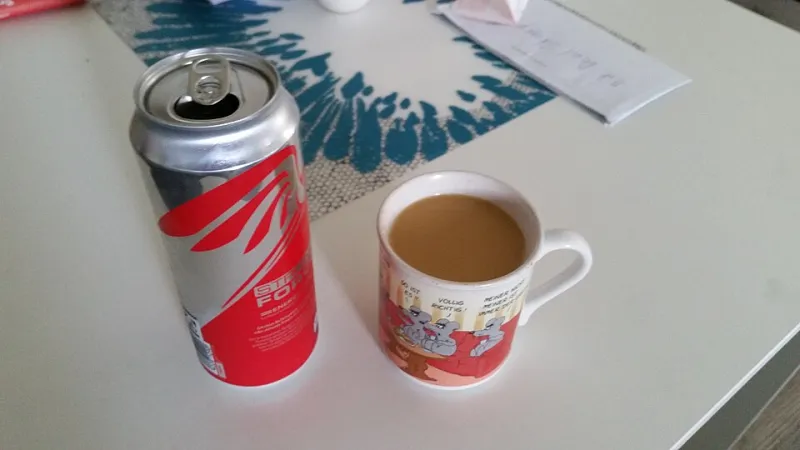
Photo: Kim Holger Kelting, CC BY 4.0, via Wikimedia Commons
Prednisone has a well-earned reputation for making people feel wired. Caffeine has the same reputation, and for many of the same reasons. Put them together and you get what patients describe as the jitter stack: a restless, buzzy, vaguely unwell feeling that is easy to blame on the steroid alone and easy to fix once you notice it.
None of this is a reason to surrender your coffee. It is a reason to be deliberate about it.
The Short Version
- Prednisone and caffeine are both stimulants, and their effects add rather than cancel.
- Sleep is usually the first casualty, and the fix is timing more than quantity.
- Caffeine on an empty stomach compounds steroid-related stomach irritation.
- Sugary energy drinks can push blood glucose in ways that look like a prednisone problem.
- Most adults can keep a moderate caffeine habit on prednisone, with adjustments.
What Each One Does Alone
Caffeine blocks adenosine, the molecule that accumulates through the day and creates what we experience as sleep pressure. Its half-life in a typical adult is around five hours, meaning a large share of a 3 p.m. cup is still circulating at bedtime. It also raises heart rate modestly, increases gastric acid, and can transiently affect how well the body responds to insulin.
Prednisone, meanwhile, is a corticosteroid that can produce insomnia, restlessness, irritability, palpitations, increased appetite, stomach upset, elevated blood pressure, and higher blood glucose. The overlap with caffeine is nearly complete.
The Jitter Stack, Item by Item
1. The double insomnia problem. Prednisone taken later in the day is a well-documented sleep disruptor. Add an afternoon coffee and you have two independent reasons for a 2 a.m. wake-up. Morning dosing of prednisone, as most prescribers recommend, helps; so does moving the last caffeinated drink earlier.
2. Palpitations and the anxiety loop. A racing heart is uncomfortable on its own. On prednisone, when anxiety is already a listed side effect, a racing heart can spiral into a genuinely distressing afternoon. Cutting caffeine during the first two weeks of a new prescription is a reasonable experiment.
3. The stomach layer. Corticosteroids increase the risk of gastric irritation, and caffeine stimulates acid secretion. Neither is a guaranteed ulcer, but the combination can produce heartburn and nausea that get attributed to the drug alone. Taking prednisone with food is standard advice; adding food to the coffee is the natural companion.
4. Sugar-sweetened energy drinks. A 16-ounce energy drink may carry 50 grams of sugar alongside its caffeine. If you are monitoring glucose during prednisone therapy, the drink itself can be the confounder. Sugar-free versions exist, but they do not solve the stimulant question.
5. Hidden caffeine. Pre-workout powders, certain headache products, some teas, and chocolate all contribute. Patients who swear they only have one cup a day are often surprised by a label reading.
6. The blood pressure interaction. Both caffeine and prednisone can raise blood pressure acutely. If your readings are creeping upward, caffeine is one of the easier variables to test.
Timing: The Eight-Hour Backstop
A simple rule that works for most people: no caffeine within eight hours of bedtime. For someone who sleeps at 11 p.m., that means a hard stop at 3 p.m. If sleep is already broken, push it to noon. The first week of a prednisone course is often the worst for sleep, so treating that week as a low-caffeine week is a sensible trade.
Portion Awareness, Without the Spreadsheet
General guidance from the U.S. Food and Drug Administration suggests most healthy adults can consume up to about 400 milligrams of caffeine daily without adverse effects. For context:
- An 8-ounce brewed coffee: roughly 95 milligrams.
- A single espresso shot: roughly 65 milligrams.
- A 12-ounce cola: roughly 35 milligrams.
- An energy drink: commonly 80 to 300 milligrams, sometimes more.
A large coffee plus an afternoon energy drink can quietly land someone near or above that ceiling, and prednisone changes the tolerance math.
A Sensible Caffeine Taper
If you want to experiment, do it in steps rather than all at once. Keep the morning cup, swap the afternoon one for half-caff, then for decaf, then for herbal tea or sparkling water. Abrupt cessation in a heavy coffee drinker produces headaches and fatigue that are easily misread as a worsening of the underlying condition.
Frequently Asked Questions
Does prednisone interact chemically with caffeine? There is no major documented pharmacokinetic interaction between prednisone and caffeine at usual doses. The concern is additive effect, not chemical conflict.
Can I drink coffee with my prednisone dose? Yes, for most people, ideally with food. If you have reflux or gastritis, take the tablet with a meal and put some distance between the dose and a large coffee.
Why does one cup now feel like three? Heightened alertness and anxiety are recognized steroid effects. If your baseline arousal is elevated, the same amount of caffeine produces a larger perceived effect.
Should I switch to decaf entirely? Not necessarily. Decaf retains a small amount of caffeine and some of the stomach-stimulating compounds. It is a useful tool rather than a guarantee.
What about tea? Tea typically carries 25 to 50 milligrams per cup, but it also contains theophylline-related compounds and can be more irritating to some stomachs than coffee.
When to Speak Up
Call your prescriber if you experience chest pain, palpitations with dizziness or fainting, blood pressure readings that are consistently high, severe anxiety or panic, or insomnia that persists well beyond the first couple of weeks. Any of these deserves a conversation rather than another cup.
Caffeine is not the villain here, and neither is your prescription. It is simply a volume knob that sits next to another volume knob, and it helps to know that both exist.